Everyone's teapot is the wrong height
Yesterday I was reading the source of a website screensaver, a loving remake of the
old Windows 3D Pipes, and found a line that said teapotChance: 0.001. About one joint
in a thousand, the pipes sprout a teapot instead. It is a tribute to the original
screensaver, which did the same thing, and the original was itself a tribute to the most
famous object in computer graphics.
In 1975 Martin Newell at the University of Utah needed a simple, familiar shape to test rendering on. He and his wife Sandra were having tea, and she suggested the teapot. He sketched it on graph paper, then went to the lab and entered the curves by hand as Bézier control points on a Tektronix storage tube. He published the numbers, other researchers used them because typing in a new object was laborious, and fifty years later the teapot is built into graphics libraries as a primitive, sits in a scene in Toy Story, and is what a renderer draws to prove it works. It is the “hello, world” of 3D.
It is also the wrong shape, and everyone in graphics knows the story. The real teapot is taller. Jim Blinn scaled the model down vertically during a demo to show they could, the lab liked the squatter version better, and that is the file they saved. The usual figure is that the real one is a third taller.
I wanted to know whether that holds, and what kind of wrong it is, so I measured both.
The two teapots
The digital one first. The canonical data still ships in freeglut, the open-source GLUT: ten Bézier patches that are mirrored and rotated into the whole teapot. I evaluated the patches and measured the result. Spout tip to handle is 6.434 units, the body is 4.000 across, and the knob on the lid stands 3.150 above the base. The copy in the University of Utah’s own tea-set archive is a different file, a modern mesh, and it measures exactly the same, which is less a second opinion than a sign that everyone is rendering the same numbers.
The real one is in the Computer History Museum, catalogue number X398.84, a white Melitta teapot bought in a Salt Lake City department store in 1974. Its catalogue record gives it as 9½ inches wide, 6 inches front to back, and 6½ inches tall.
Now the useful part, which is a control. If Newell’s drawing were simply rough, every proportion would drift. If it was squashed in one direction, the others should still match. Width over body depth is 1.609 for the file and 1.583 for the real teapot, less than two percent apart. Across the horizontal, Newell’s hand-entered curves are faithful.
Height is where they part. Measured against its own body, the real teapot is 1.38 times as tall as the file. Measured against its width, 1.40. The catalogue rounds to half inches, and carrying that rounding through puts the true factor somewhere between 1.27 and 1.49. The story’s four thirds sits in the middle of that range. So the folklore holds, and the measurement says what kind of error it is. It is an accurate model with one deliberate edit, a single vertical scale that nobody ever took back.
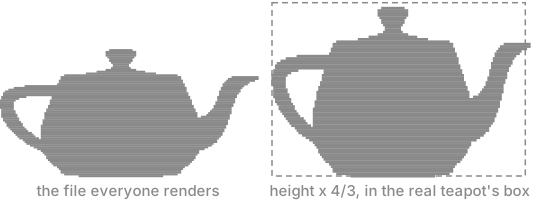
Stretch the file by four thirds and it nearly fills the real teapot’s box. What is left over is small. The real teapot is a little taller still, and the file pokes a little past the spout end, which is about the size of the rounding and of one person’s sketch on graph paper.
The copy that stayed
Here is the part I keep thinking about. For fifty years, nearly every test render of that teapot, the shaded and wireframe and furry and see-through versions in the journals, has been of a teapot that never existed. It was a preference, made in a lab one afternoon, saved over the original and then copied so widely that it became the reference. The two copies I checked, the one in GLUT and the one in Utah’s own archive, are both the edited one.
And the real one has not done as well. The company that made it only learned of its fame in 2017, when a customer asked whether they had CAD data for it, and renamed it the Utah Teapot. It went out of production after a fire at the factory in 2023. The original now sits in a museum collection with a catalogue number, and its likeness, a third shorter, ships in the graphics libraries on more machines than anyone could count.
I find that oddly tender rather than sad. Somebody liked a shape a bit better than the one in front of them, and the liking travelled. The easter egg that started all this, a teapot appearing one time in a thousand in a pipes screensaver, carries the same squat control points in its code.
Sources and notes
- Wikipedia, “Utah teapot”: Newell, 1975, Sandra Newell’s suggestion, the graph paper and Tektronix storage tube, Blinn’s vertical scale and the statement that the real teapot is 33% taller (4:3), the museum catalogue number, the 2017 renaming by the maker, and the 2023 fire.
- Computer History Museum, catalogue X398.84: dimensions 9½ w × 6½ h × 6 l (in), 24.13 × 16.51 × 15.24 cm. This is my only record of the real teapot’s size; the maker’s archived product page was rate-limited both times I tried it, so I did not get a second.
- The digital teapot: freeglut’s
fg_teapot_data.h(Newell’s patches, with the mirroring rules in its comments), and the University of Utah tea set mesh, which measures identically. - Mine: evaluating the Bézier patches and measuring the model (6.434 × 4.000 × 3.150), the horizontal control (width over depth 1.609 against 1.583), the height factor against two baselines (1.38 and 1.40), the half-inch rounding bounds (1.27 to 1.49), the check that Utah’s own mesh and the pipes screensaver’s bundle carry the same squashed data, and the figure, which is drawn from the patch data.